Churches & Cemeteries

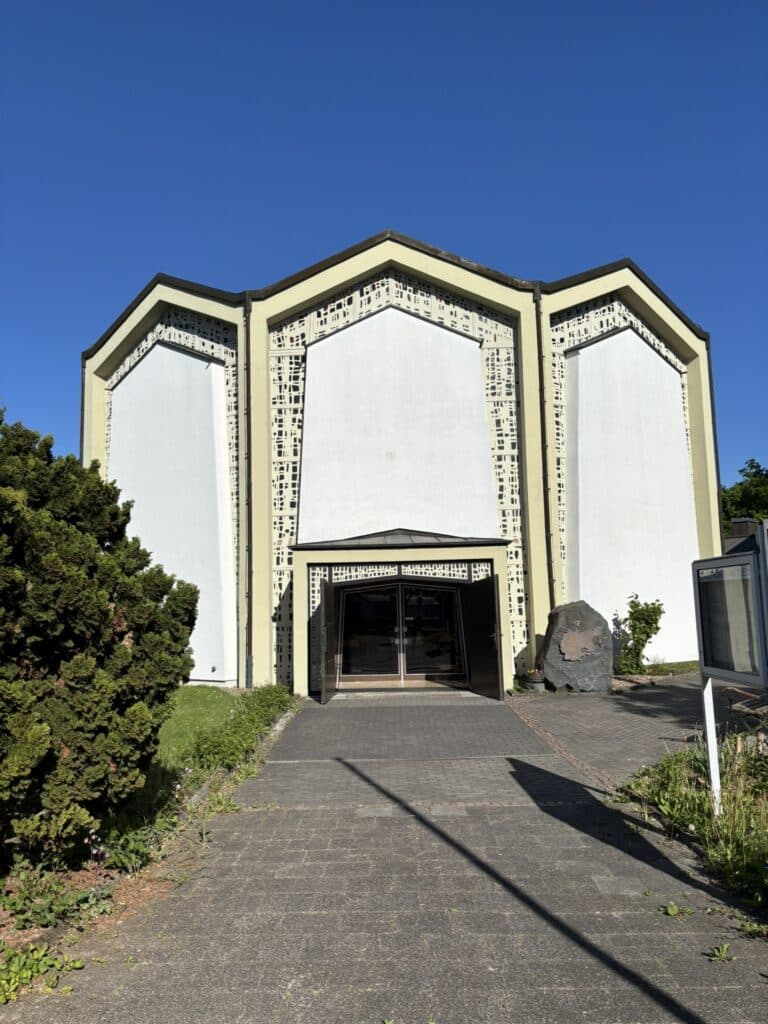
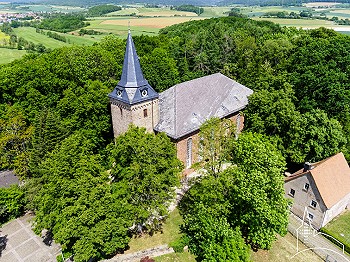
The „Auf dem Berg“ (On the Mountain) parish, with four pastoral positions and nearly 8,000 members from the Gründau districts and the Roth district of the municipality of Gelnhausen, is the largest parish in the Evangelical Church of Kurhessen-Waldeck. The ecclesiastical center is the Bergkirche (Mountain Church) in Niedergründau (first documented in 1217) with a community hall. Numerous cultural events also take place here. The sound of the Ratzmann organ (1839) is also a treat for the ears. In the other districts, newer sacred buildings were erected as chapels and community centers: These include the Paul-Gerhardt-Kirche in Lieblos with a community center, where the parish office is also located. For Rothenbergen, there is a community center with the youth office, as well as the Mittelgründau church and the chapel in Gettenbach. Since January 1, 2017, Breitenborn has belonged to the "Auf dem Berg" Protestant parish. In the Gelnhausen district of Roth, a church room has been provided in the old school.

Above Niedergründau is the mountain church:

Information about Bergkirche Niedergründau, the Ratzmann Organ Support Association, and the concerts held at Bergkirche can be found on a separate website for Bergkirche Niedergründau, which is maintained by the support association.

Parish Office Evangelical Church "Auf dem Berg"

A church service is held weekly at the Laurentiuskirche in Hain-Gründau on Sundays at 10:30 AM. Additionally, the beautiful, small church is chosen by many engaged couples as their wedding venue.
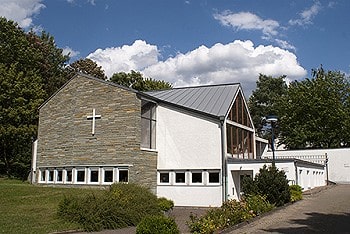
The district (parish with three congregations) belongs to the United Methodist Church.
The name United Methodist Church is still quite young. It stems from a merger of two free churches: the „Evangelical Association“ and the „Methodist Episcopal Church.“ They united worldwide in 1968 to form the United Methodist Church (UMC). In English-speaking countries, it is called the United Methodist Church, and similarly in other countries.

Worldwide, this church has 13 million members; membership is obtained by application and acceptance, not by baptism.

The United Methodist Church is the largest church belonging to the World Council of Methodist Churches with nearly 80 million members.

Pastor Ralf Schweinsberg

Part-time pastor Angelika Grob

On January 1, 2021, several church communities, including Christkönig Gründau, merged to form the new Catholic Church community of St. Raphael.


The central parish administration is located in the Deutschordenshaus at Holzgasse 17 in Gelnhausen.


The contact point at the Christ King Church, located at Niedergründauer Str. 20 in Rothenbergen, is open once a month on Tuesdays from 2:30 PM to 5:30 PM. You can find more information about the opening hours on the parish of St. Raphael's homepage at katholische-kirche-raum-gelnhausen.de.

Catholic Parish of St. Raphael

Church of Christ the King

In the cemetery administration, all data necessary for burials are stored.

The cemetery administration provides information on grave locations, burial fees, and the duration of usage and burial periods.

In terms of burial methods, we differentiate between earth burial (burial) and cremation (incineration and urn burial).

The choice of funeral type is generally up to the deceased's next of kin.

In principle, earth burials and ash burials may only take place on public burial grounds, i.e., the seven municipal cemeteries.

Choice of Burial Plot
The cemetery administration staff will be happy to advise you on choosing a burial plot, as this decision is generally irreversible and requires careful consideration.
For your information, here are the essential differences between family graves, designated graves, or urn graves.


Row graves


§ 18 Definition of an Ash Plot

(1) Row graves are graves for earth burials. They are occupied in sequence and assigned in the event of death for the duration of the burial period of the person to be buried. Resale or extension of the right of use for a row grave is not possible. Only for maintenance purposes, an extension of the maintenance right for a period of no more than five years is possible upon request at the end of the burial period. However, there is no general legal entitlement.

(2) Existing row graves can be converted from a single-occupancy row grave to a single-occupancy selectable grave upon application by the rights holder, for the fee of a selectable grave.

There is no legal entitlement to conversion. The cemetery administration makes the decision.

The retention period until a grave site can be re-leased is 30 years for deceased persons aged 5 and older, and 20 years for deceased persons under the age of 5.


The resting period before a grave plot can be reoccupied is 30 years for corpses.

Row graves are located within a specially designated part of a cemetery. The graves are assigned in sequence.

Ashes may be interred in row graves for earth burials, provided that the last earth burial did not take place more than 10 years ago. In each grave site, at most one additional urn may be interred alongside the earth burial.


Grave sites of choice


§ 21 Definition, Origin, and Transfer of Usufruct

(1) Choice burial plots are plots for earth burials, for which a right of use is granted for a period of 35 years (period of use) upon request. There is no legal entitlement to the granting of a right of use for a choice burial plot. The initial acquisition of a right of use is only possible in the event of a death. The right of use can generally be reacquired or extended once. Reacquisition or extension are only possible upon request and only for the entire choice burial plot. There is no legal entitlement to an extension or reacquisition. An exception to this applies to extensions or reacquisition for a choice burial plot that is not fully occupied.

(2) Reacquisition of a right of use for a memorial grave site is understood to mean the granting of a second period of use. The application can be submitted no earlier than six months before the right of use expires.

The extension of the right of use covers a shorter period than the complete period of use.

Reacquisition and renewal are subject to the payment of a corresponding fee in accordance with the cemetery fee regulations.

(3) Single- to three-place grave plots are available. One earth burial and one urn burial are possible in single-place grave plots. In two-place grave plots, two earth burials and up to two urn burials are possible. (according to §16 para. 4 of the Cemetery Regulations)
After the exhumation period of a corpse has expired, a further burial can take place in the respective grave site if the remaining term of use reaches the exhumation period or the right of use has been reacquired or extended for at least the period until the exhumation period expires.

(4) The right of use is established upon handing over of the deed of grant. The user has the right to burial after their death, and in the case of acquiring a multi-occupancy choice grave, the right to burial of their deceased relatives in that choice grave. Relatives in the sense of this provision are:

1. Spouses,
2. Life partner according to the Life Partnerships Act
3. Relatives in direct ascending or descending line, adopted children, and siblings,
Spouses and registered partners of the persons referred to in Section 4, Paragraph 3, Number 3.

The burial of other persons in the family grave requires the consent of the cemetery administration.

(5) The right of use of a choice grave can only be transferred with the consent of the cemetery administration and only to relatives within the meaning of § 21 Para. 4.

The acquirer of a designated grave plot shall designate their successor in the right of use in the event of their death. This successor must be appointed from the circle of persons listed in § 21 para. 4. If no arrangement is made or a specific person waives their right, the right of use shall pass to the relatives of the deceased acquirer in the order mentioned in § 21 para. 4. Within each group, the oldest person shall be entitled to use the plot. The same applies to the death of a person entitled to use who had previously inherited the right of use.

Any person to whom a right of use is transferred may waive this right of use by declaration to the cemetery administration.

(7) The right to burial in a grave with a designated plot expires with the period of use. However, during the period of use, a burial may only take place if the period of repose for this burial does not exceed the period of use, or if the right of use has been reacquired or extended for at least the period until the expiration of the period of repose for this burial.

(8) Entitled persons may waive their right to still vacant or already occupied burial plots, for which the resting period has expired or for which a resting period still exists. The waiver must be declared upon return of the grant certificate. A pro-rata refund will not be granted in the event of a waiver of the right of use.


Urn burial sites


§ 23 Forms of Ash Interment

(1) Ashes may be interred in

a) Urn grave sites,
b) Urn burial plots,
Gravesites for earth burials,
d) Urn walls (columbaria),
e) a field for anonymous urn burials,
f) Burial sites at specially designated trees (Rothenbergen)
Grave plots around trees
Community grave sites

In rows of urn graves, selectable urn graves, a field for anonymous urn burials, tree graves, lawn graves, community grave sites, and graves for earth burials, ash urns may only be interred underground.


§ 24 Definition of a family grave plot

(1) Urn niche graves are burial plots intended for urn burials. They are occupied in sequence and assigned for the burial of an ash urn for the duration of the burial period. Extension of the usage right or repurchase is not possible. An extension of the maintenance right for a maximum of five years is possible exclusively for maintenance purposes at the end of the burial period, upon request. However, there is no general legal entitlement.

Since January 2013, tree burials have been possible for Gründau citizens at the cemetery in the Rothenbergen district, in accordance with Section 28 of the Cemetery Regulations. As of 01/01/2017, there will be tree grave sites at all Gründau cemeteries in accordance with Section 29 of the Cemetery Regulations.

Tree burial is a relatively new type of burial that is requested more and more often. The urn is buried in the root system of a specially designated tree. By burying the deceased in the root area of trees, their physical shell is intended to return to the natural cycle. The concept of tree burial primarily appeals to nature-loving people.

Due to the professional flexibility of descendants, longer journeys to the graves of the deceased often arise. In recent years, grief behavior has also changed. Due to time constraints, sustainable grave care is practiced less frequently. Therefore, low-maintenance grave sites, such as tree burials, are increasingly desired. The advantage of a tree burial is that no individual tending of the grave site is necessary for the relatives, but a dignified resting place and a space for grief work are still available. The point of reference is the tree, not the burial site in the ground. The tree is the gravestone with the symbolism of permanence and steadfastness.

It is partly a family tradition to bury the dead near their place of residence, in order to find eternal rest near their ancestors later. Tree burials within a cemetery also have the advantages of having a funeral hall there and being close to the residence of the bereaved.

In Gründau, the following information is important to know for making a decision about which burial site is right for me or my relatives.

Burial in a tree grave plot may only take place in a biodegradable urn. The placement of grave arrangements, flower bouquets, or similar items is only permitted during the burial itself. Further use of the grave plot is prohibited.
The tree burial site is marked by the cemetery administration on a memorial plaque placed around the tree, on which the surname, first name, date or year of birth and death can be engraved.

The acquisition of a right of use in Gründau is only possible on the occasion of a death.

For questions regarding burial options in Gründau, the cemetery administration, Ms. Schinzel, will gladly provide information by phone at 06051/8203-23 or in person at the town hall in Gründau, district Lieblos, Room 1.

The following general design regulations apply to all cemeteries in accordance with Section 30 of the Cemetery Ordinance, which came into effect on January 1, 2017:

Each grave site must be designed and adapted to its surroundings in a way that upholds the cemetery's purpose, the dignity of the place, and reverence.

2. Gravestones and other grave decorations may be erected on graves, with the exception of gravesites for anonymous urn burials, particularly to commemorate those resting there. Gravestones and other grave decorations must be made of weather-resistant material.

3. Tombs and other grave furnishings must be stable in accordance with § 32.

4. The minimum thickness of headstones is 0.14 m for heights from 0.40 m to 1.0 m, 0.16 m for heights from 1.00 m to 1.50 m, and 0.18 m for heights above 1.5 m.

5. The closure panels of the urn wall chambers, as well as the slab of the grave sites by the tree and the communal burial area, will be provided by the municipality; they must be engraved without delay. The design for this must be submitted to the cemetery administration for approval; it must include the name, year of birth, and year of death.

6. The marking of the tree grave site in Rothenbergen is carried out by the cemetery administration on a memorial plaque placed in the vicinity of the tree, on which the last name, first name, birth date, and death date or year will be engraved.

Company names may only be affixed to tombstones, and in an unobtrusive manner on the side.

According to § 31 Requirement for Approval of Gravestones and Grave Borders, it states:

(1) The erection and any alteration of tombstones and grave surrounds require the prior written consent of the cemetery administration. Without consent, temporary tombstones made of wooden tablets up to 15 x 30 cm and wooden crosses are permitted for a period of up to two years after the burial.

(2) The approval must be requested by submitting drawings in duplicate at a scale of 1:10. All details of the installation, particularly the type and processing of the material, as well as the content, form, and arrangement of the inscription, must be evident on the application and the drawings. Upon request, drawings on a larger scale or models must be submitted.

(3) The erection and any alteration of other grave furnishings intended for permanent installation, such as holy water basins, candle holders, special stones for inscriptions, etc., also require the prior written consent of the cemetery administration. Paragraph 2 shall apply accordingly.

(4) Consent expires if the tombstone, grave enclosure, or other grave furnishings have not been erected within two years of consent being granted.

(5) Erected without prior written consent from cemetery management
Or, installations that do not conform to the submitted drawings and specifications must be removed or modified to conform to the drawings and specifications. The cemetery administration may request in writing that the person responsible for or entitled to use a grave remove or modify the installation within a reasonable period. If the request is not complied with in a timely manner, the installation may be removed by the cemetery administration through enforcement. The costs incurred in doing so are to be reimbursed by the obligated party.


A fee of 50.00 Euros is charged for this permit to erect tombstones.


Arrangement, planting, and maintenance of graves
§ 34 Planting of Grave Sites


(1) All graves – with the exception of urn walls, the area for anonymous urn burials, the communal burial site for stillborn children and fetuses, and tree graves – must be planted and permanently maintained. When planting and maintaining, environmental protection concerns, particularly water and soil protection, must be taken into account.

(2) Only suitable plants may be used to landscape gravesites, provided they do not negatively impact other gravesites or public facilities and pathways. Planting, relocating, or removing trees, large shrubs, and hedges requires prior approval from the cemetery administration. Users of a gravesite are liable for any damage caused to monuments, grave borders, or other grave furnishings of adjacent gravesites, or to public facilities and pathways, by trees, shrubs, hedges, or similar plantings on their gravesite.

(3) Only wreaths, grave arrangements, or similar grave decorations made exclusively from biodegradable materials may be placed on gravesites.

(4) Withered flowers and wreaths are to be removed from the graves by the users. If this is not done, the cemetery administration may remove the flowers and wreaths after an appropriate period without notice.

Flowers, wreaths, and other floral grave decorations removed from gravesites may only be placed in the containers specifically provided for them or in designated areas.

(5) No substances that can cause groundwater contamination may be used for weed control.

(6) The preparation, maintenance, and alteration of garden facilities
outside of the gravesites, it is solely the responsibility of the cemetery administration

(7) Watering cans, spades, rakes, and other tools may not be stored on gravesites or behind gravestones and in plantings.


§ 35 Obligation of Preparation and Maintenance Worthy of a Cemetery


(1) All graves must be laid out and permanently maintained in accordance with the regulations in § 34.

(2) Row and urn row graves must be prepared within 6 months of burial. Choice and urn choice graves must be prepared within 6 months of acquiring the right of use or the last burial, respectively.

(3) If a row grave, during its resting period, or an elected grave, during its right of use, is not maintained and cared for in a cemetery-worthy manner for an extended period, the user(s) shall be given a reasonable written period to carry out the necessary work. If the period for maintenance and care of the grave expires without the required work being done, the cemetery administration may have the grave cleared, leveled, and sown at the expense of the user(s).

In all Gründau cemeteries:

Urn burials

Length 100 cm Width 90 cm
Exception: In the Rothenbergen cemetery, grave field 7a; Length 90 cm, width 100 cm

Row graves
Length 200 cm Width 80 cm

Single-seater graves possible from 01/01/2017
Length 200 cm Width 80 cm


Multi-digit choice graves
Two-digit burial plots 200 cm long, 200 cm wide
3-digit grave wreaths, 200 cm long, 300 cm wide

According to § 9 Pursuant to our cemetery regulations, which come into effect on January 1, 2017, you require our prior approval to conduct your commercial activities in our cemeteries.

Therefore, we request that you submit your trade registration in the craft roll or directory according to § 19 of the Crafts Code (Handwerksordnung), as well as proof of your master craftsman examination or an equivalently recognized qualification from you or your technical representative.

According to § 9 (4) Cemetery regulations may allow the cemetery administration to make approval conditional on the applicant providing proof of sufficient liability insurance for the performance of their activities. Therefore, we kindly ask you to also submit your proof of liability insurance.

Furthermore, we kindly ask you to indicate the exact dimensions of the grave on your sketch, e.g., thickness and diagonal of the grave cover slabs, thickness and height of the edging, thickness and length of the dowels, what type of foundation you are making, etc.

The Five-year eligibility card for the execution of commercial work costs 50.00 Euro fee.

One One-time permit costs 15.00 Euro charges. Before erecting a grave monument, a permit must be obtained in accordance with § 31 of the Cemetery Regulations.

Once we have received the required documents from you, we will send you the authorization card.

§ 32 Structural Stability

(1) Grave monuments must be founded and secured in accordance with the generally recognized rules of the trade, as established in the guidelines for the foundation and setting of grave monuments issued by the Federal Guild Association of the German Stonemason, Stone, and Wood Sculptor Trades (Setting Guidelines), such that they are permanently stable and cannot collapse or sink when adjacent graves are opened. This applies accordingly to other built structures.

With the application for approval according to § 31 sec. 2, written information about the type of foundation and fastening, especially the size and strength of the foundations, must be submitted. If the stability of a tomb is not ensured by the foundation and fastening provided, the cemetery administration may prescribe the necessary changes. The cemetery administration may check whether the prescribed foundation has been carried out and, if necessary, demand corrective action.

(2) The owner or usufructuary of the grave site is obliged to have the tombstone professionally inspected for its stability at least once a year, after the frost period has ended, or to have it inspected by professionals at their own expense, regardless of whether external defects are visible or not. Defects found during this inspection must be rectified or cause to be rectified immediately at their own expense. Owners of grave sites and usufructuaries who do not properly fulfill these obligations are liable for any resulting damages.

(3) If the unlawful condition of a gravestone or other structures is not remedied within a reasonable period to be determined by the cemetery administration, despite written notice from the cemetery administration, the cemetery administration is entitled to provisionally secure (e.g., laying down gravestones, cordoning off) or remove the gravestone or parts thereof at the expense of the responsible party. The municipality is obligated to store these items for three months. If the responsible party is unknown or cannot be identified without undue effort, a public notice and stickers attached to the gravestone or other structure for a period of one month shall suffice as notice.

Notification is not required in case of immediate danger.

(4) Gravestones and structures of artistic or historical value, or those intended to be preserved as a special feature of a cemetery, shall be listed in a register. The cemetery administration may refuse consent to alter such gravestones and structures. To this extent, the responsible monument protection and care authorities shall be involved in accordance with statutory provisions.

Tombstones, grave surrounds, and other grave furnishings may only be removed from the grave site before the expiration of the burial term or right of use with the prior consent of the cemetery administration.

Upon expiration of the repose period for row graves and urn row graves, or upon expiration of the usage period for allocated graves and urn allocated graves, grave markers, borders, and other grave furnishings must be removed by the rightful users within 3 months.


If the entitled users do not comply with this obligation, the cemetery administration is entitled to have the grave site cleared. The cemetery administration is not obligated to keep any headstones or other structures. Headstones or structures become the property of the city/municipality without compensation, provided that this was agreed upon in writing at the time of acquiring the right of use or when permission was granted for the erection of the headstone or other structures.

If no such agreement has been made, the cemetery administration may proceed according to the provisions of §§ 383 et seq. of the German Civil Code (BGB). If gravestones or other structures are removed by the cemetery administration, the respective user shall bear the costs incurred.

Petra Schinzel

Verena Walther